
How the Market Is Reacting to The Chip Crisis Part 1
The Secondary and Used Markets
4/30/20264 min read
In our previous two blogs in this series, we outlined higher pricing and scarcity, as well as less-publicized factors affecting the broader server, workstation, and adjacent chip market.
But how has the industry responded? In this update, my teammate Rich Narain and I discuss the secondary and used markets and how they are responding to changing market conditions.
What Is the Secondary Market?
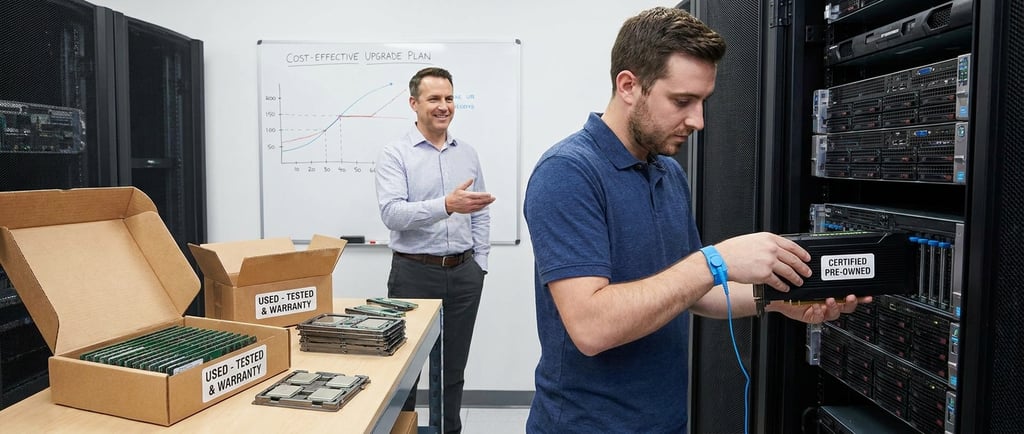
The terms “used market” and “secondary market” are often used interchangeably. However, the secondary market includes manufacturer- or reseller-certified or refurbished equipment, overstock, new-in-box surplus, or off-lease equipment sold by specialized vendors.
Meanwhile, the used market refers to peer-to-peer sales of previously owned equipment typically associated with platforms such as eBay, Facebook Marketplace, or Gumtree. In addition, secondary market products often come with a warranty, while used items are generally sold as-is.
How the Secondary Market Is Helping
If you are in a position where you need functional products and new equipment is not essential, leveraging the secondary market can be a good option. While this is not practical in all cases or regions – for example, in some parts of Latin America importing used hardware is not permitted by law – it does address real-world needs.
It is common for fabs to produce chips that do not fully meet performance or functional specifications. These are typically set aside. However, there are cases where less-performant hardware is repurposed or sold with reduced performance characteristics.
Examples include underperforming Sony PS5 APUs repurposed as ASRock BC-250 crypto mining cards, and more recently, Intel selling CPUs with lower performance capabilities to meet market demand. In these cases, they are legitimate new products using components that were not suitable for their original purpose or did not meet ideal design specifications.
There is also certified or refurbished hardware such as RAM, GPUs, storage, and CPUs that re-enter the market. For example, this author purchased a refurbished Nvidia GPU for local AI workloads and saved more than 25% compared with new market pricing a few months ago. It came with a warranty, appeared new, and performs reliably.
In many cases, the secondary market helps address cost pressures and enables projects to move forward. It can act as a bridge, allowing organizations to avoid paying well above MSRP while navigating refresh cycles. By contrast, purchasing new equipment at inflated prices may result in reduced project scope, longer amortization periods, or delays while waiting for pricing to stabilize.
How Recycling Has Changed in Response to Limited Supply
Recycling electronics used to be a low-value activity. The chip crisis has changed this, with RAM, GPU, CPU, and storage harvesting and resale creating a growing opportunity for recyclers.
Much of the used market inventory comes from hardware deemed incompatible with Windows 11, as well as from failed businesses and data center refresh cycles. While these components may not be cutting-edge, they may still be sufficient for many use cases.
This raises important questions: “Is this good enough for my needs?” and “How can I assess reliability in used hardware?”
As Rich Narain put it:
“Procuring recertified equipment for companies that do not require the latest technology is a viable solution and can often be done at a lower acquisition cost while still meeting project timelines. Using refurbished equipment to bridge the supply gap can also provide advantages beyond cost savings, depending on lifecycle needs. It can allow companies to skip a technology refresh cycle and wait for greater maturity in current or future technologies before making another investment.”
Some people will not buy a used or certified pre-owned car, just as some organizations avoid secondary market or used computer hardware. However, where price is a constraint, the used market provides a viable alternative. The guidance is simple: proceed with caution and buy from trusted or well-known suppliers whenever possible.
There are reputable vendors that provide these services for components and systems, along with third-party providers that offer extended hardware warranties for a fee. It is also important to note that some third-party providers support OEM warranty logistics.
Rich added:
“In the past, I have worked with a third-party vendor that provided manufacturer warranty and extended support for one of our OEM partners and successfully extended warranty coverage for customers beyond the original manufacturer support period.”
Purchasing refurbished systems through reputable channels and the right partners helps reduce reliability risk.
Alternate Parts
Switching vendors for form-, fit-, and function-equivalent parts can be unpalatable for some organizations, as it often requires revalidation and testing to ensure systems meet required standards.
For many customers, flexibility in equipment selection should not be the primary concern. Instead, the focus should be on validating systems that meet their requirements. In the past, some customers insisted on identical components or systems, but shorter lifecycles and supply constraints now require greater flexibility.
OEM vendors do this routinely. They typically qualify multiple manufacturers on their approved vendor list (AVL) to mitigate quality, price, and supply risks. When purchasing a branded server or workstation, customers usually have little visibility into which suppliers provided components such as RAM, storage, or power supplies. These components are built and validated to defined standards.
Should this be a concern? In most cases, no, because the OEM stands behind the system and guarantees it meets performance specifications.
What Should You Do?
There are no perfect answers, as current conditions remain challenging. However, viable alternatives exist when inaction is not an option.
If in doubt, seek guidance. OXI Media can help evaluate options and support sourcing and purchasing decisions across secondary and used markets.
Contact
Reach out on social media, email, or by phone
© 2026. All rights reserved.