
How the RAM Crisis is Affecting Production and Broadcast Applications
If you need to buy servers and workstations in the near term, high prices are unavoidable. Here's what you should know as Q2 2026 gets started.
Andy Warman
4/3/20264 min read
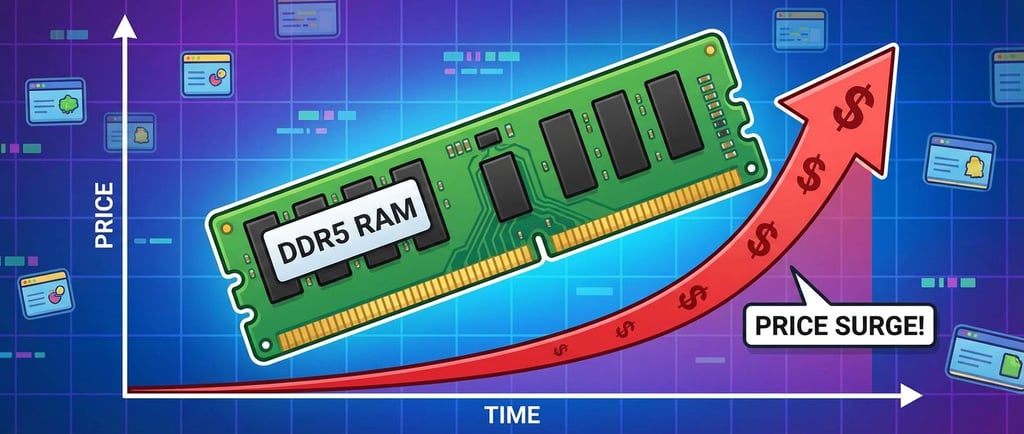
The focus on rising RAM prices has mainly targeted tracking RAM and GPUs fluctuations. However, there is more in play due to the reality that consumer products are not used in the broadcast and production system purchase, and that the real competition is for server hardware coming from AI and cloud datacenters.
One of the most significant side effects of this is limited or no price guarantees from vendors. Pricing is tied to RAM and GPU prices, and since these are fluctuating frequently, locking in a quote for any period of time is a challenge.
Purchasing Options
The overall situation remains grim, with high prices, shrinking inventory, and potential for long lead times and a lack of clarity on when this situation might improve. This leaves buyers with several options to consider when balancing cost, timelines, and the importance of each project:
If you must buy hardware for an upcoming project:
Lock specs early
Ask your vendor(s) if they will give you a price guarantee (fewer are doing so due to their own supply chain issues)
Pre-buy critical spares where possible
Avoid designs that depend on a single SKU or exact make and model specs
If cloud is an option, it will look more attractive than ever. It can work for you if:
Cloud solves the workflow needs
There are no content or other cloud sovereignty concerns
You are using cloud to delay a purchase
Look at alternative designs that rely on more FPGA/ASIC based hardware
Deprioritize compute-based processes where other alternatives exist
Use PCs, including where GPU processing is needed, only for the most pressing functions
Future proofing with extra RAM, better CPUs and/or GPUs may need to take a back seat. Hardware that is upgradable later is still an option
Consider solutions that reuse existing computer systems
Consider vendors who can run on the systems you already have
Plan system migration strategies with care to avoid outages and lack of resources
Consider managed services
Avoid designs that depend on a single SKU or exact make and model specs
Delay projects where practical
Timelines to lower pricing and better availability remain uncertain, but if you can avoid investing now, it may be worth it in the long run
ECC RAM
If you are rolling out workstations or building a server system, datacenter, or local AI for your business, you’ll be buying PCs with ECC (Error-Correcting Code) memory. This differs from the RAM found in standard office desktop PCs (DIMM) and laptops (SODIMM) as ECC RAM can detect and automatically fix single bit memory errors with specific hardware that ensures data integrity. As a result, consumer products and trends are not the ones to watch.
For system RAM, barring a few outlier products, major server vendors have transitioned their portfolios to DDR5 RAM, playing directly into the heart high RAM pricing. Inventory has fallen significantly, with drops from ~31 weeks in 2023 to ~8 weeks at the end of 2025, and likely lower now at the start of Q2 2026.
ECC RAM Price Surges – the Price Trend (2024–2026)
In Q2 2026 we may see a 500% increase in EEC RAM pricing compared to 12 months prior. Any indication of when prices may fall has yet to materialize, with analysts offering a variety of views from a mid-2026 to early 2027 downturn, to 3 or 4 more years of high or rising prices.
Mid 2025: A 32GB ECC RAM kit was ~$95 in the middle of 2025, with prices showing moderate upward trend as demand for AI server hardware began to grow and consume production capacity.
The Surge begins – Late 2025: The second half of 2025 saw a rapid acceleration in pricing, with 32GB ECC RAM modules increasing from approximately $90 in late 2025 to north of $150 to $180 by early 2026.
2026 Year to Date (as of 1 April): ECC DDR5 32GB kits that cost around $95 in July 2025 surged to over $350–$500 by December 2025, with projections of reaching $550 to $600 in Q2 2026.
GPUs
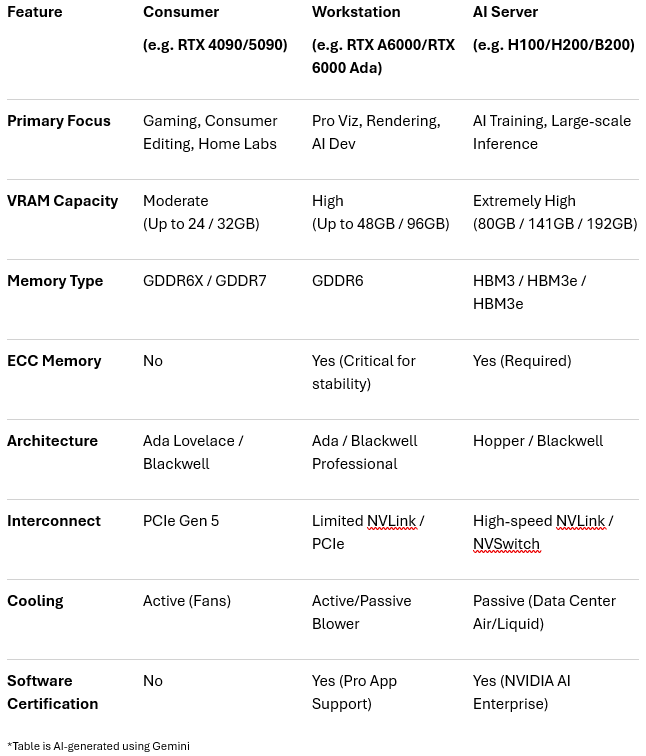
GPUs are in high demand for AI applications and use RAM too though not the same type as seen in system RAM. Much like consumer versus workstation and server-grade RAM, professional GPUs are also in separate categories from consumer versions. It’s important to note that workstation/server GPUs you might use for local AI development and graphics production are different from those aimed at AI servers used for AI training.
Workstation graphics cards have not seen quite the same pricing volatility as RAM though high prices are still an issue. For example, the RTX 6000 Ada’s launch price was $6,800 USD for the 48GB model. In the past 2 years prices have risen, and in Q1 2026, prices ranged from $6,400 to $14,000+ depending on brand (e.g. PNY vs HP) and sourcing (Amazon vs HP reseller).
The following comparison chart highlights the key differences using Nvidia GPUs since these are the most prevalent in the media workflows:
Conclusion
If you need to buy in the near term due to obsolescence, support or other needs or issues, high prices are unavoidable for the foreseeable future. Short to mid-term project delays are no guarantee of lower prices since there is no clear end to the crisis.
While Google’s TurboQuant might sound like sound like a savior of sorts since it can save on KV cache up to 6x, it is still a lab breakthrough and does not materially impact the broader need for RAM for training models. Meanwhile, it remains to be seen if OpenAI’s letter of intent to Micron and Samsung rather than firm orders the industry had taken them for will materially change prices and availability.
We’ll be keeping an eye on this situation and post updates as new information comes to light.
References:
“Memory Price Trends.” PCPartPicker, March 2026 https://pcpartpicker.com/trends/price/memory/. Accessed 1 April 2026.
“RAM Prices Hit $550 in Q2 2026: How IT Asset Recovery Timing Affects Hardware Refresh ROI.” Discount Computer Depot, 2 February 2026
https://discountcomputerdepot.com/ram-prices-hit-550-q2-2026/#:~:text=The%20global%20memory%20shortage%20that,aligns%20with%20peak%20market%20pricing
“When Will RAM Prices Drop? Global Memory Market Outlook 2024–2026.”, bacloud.com, 12 Nov 2026
https://www.bacloud.com/en/blog/230/when-will-ram-prices-drop-global-memory-market-outlook-20242026.html?spm=a2700.accio_bizSeo.0.0.69032e84PhhfO2
“RAM prices trend over time”, 26 March 2026
https://www.accio.com/business/ram-prices-trend-over-time
Contact
Reach out on social media, email, or by phone
© 2026. All rights reserved.